

Introduction
The cryptocurrency market continues to evolve rapidly, introducing new digital assets designed to improve speed, security, and decentralization. Among emerging projects, BitClassic coin is gaining attention from investors and blockchain enthusiasts looking for innovative yet practical solutions in the crypto space.
But what exactly is this project, and how does it function within the broader digital economy?
Understanding a cryptocurrency requires more than just checking its price chart. Investors today want to know the technology behind the network, its token distribution model, long-term roadmap, and real-world use cases. Transparency, sustainability, and strong fundamentals are key factors when evaluating any blockchain-based asset.
In this comprehensive guide, you’ll learn what BitClassic is, how bitclassic blockchain works, its core features, tokenomics, potential applications, and how it compares with established cryptocurrencies. Whether you’re a beginner exploring digital assets or a seasoned crypto trader researching new opportunities, this article will provide clear, structured, and practical insights to help you make informed decisions.
What Is a BitClassic Coin?
BitClassic coin is a blockchain-based digital asset created to facilitate secure, decentralized transactions without relying on traditional financial intermediaries. Like other cryptocurrencies, it operates on distributed ledger technology, ensuring transparency and immutability.
At its foundation, the project focuses on:
- Enabling peer-to-peer transactions
- Reducing dependency on centralized systems
- Offering transparent and traceable transfers
- Supporting ecosystem development
Core Characteristics
- Operates on a decentralized blockchain network
- Transactions verified by nodes or validators
- Uses cryptographic security mechanisms
- Publicly viewable ledger
Unlike purely speculative tokens, the project positions itself as a structured initiative with defined goals and a community-driven ecosystem. bitclassic aims to balance innovation with reliability, focusing on practical adoption rather than short-term hype.
Why It Matters
In a market filled with thousands of cryptocurrencies, differentiation is essential. Projects that emphasize usability, governance, and sustainable growth tend to attract long-term interest. Understanding these foundational aspects helps investors evaluate its credibility and long-term viability.
The Vision and Purpose of the Project
Every blockchain initiative begins with a mission. The goal behind this cryptocurrency centers on building a decentralized financial infrastructure that is efficient, scalable, and accessible to global users.
Strategic Vision
- Promote financial inclusion
- Reduce transaction costs
- Encourage blockchain adoption
- Empower community participation
Mission Objectives
- Develop scalable network infrastructure
- Support ecosystem expansion
- Maintain transparency in operations
- Foster long-term value sustainability
A strong vision provides direction and consistency. Investors often review whitepapers and roadmaps to determine whether a project has a realistic development plan.
Importance of Clear Direction
Cryptocurrency projects without a roadmap often struggle to gain trust. Key indicators of credibility include the following:
- Clearly defined milestones
- Transparent development updates
- Active community engagement
- Responsible token management
By outlining measurable objectives and maintaining open communication, the project aims to strengthen user confidence and establish a solid presence in the blockchain industry.
How the Blockchain Network Works
To understand the functionality of this digital asset, it’s important to examine the underlying blockchain system.
Core Mechanism
The network operates through:
- Distributed nodes maintaining the ledger
- Consensus mechanisms validating transactions
- Cryptographic hashing for security
- Block creation and confirmation
Depending on its architecture, the network may use the following:
- Proof-of-Work (PoW)
- Proof-of-Stake (PoS)
- A hybrid model
Key Components
- Validators/Miners: Confirm transactions
- Wallets: Store and transfer tokens
- Smart contracts (if supported): Automate agreements
- Explorer tools: Provide transparency
Benefits of Decentralization
- No central authority
- Reduced fraud risks
- Immutable transaction history
- Increased transparency
This structure ensures that transactions remain secure and verifiable, reinforcing trust across participants.
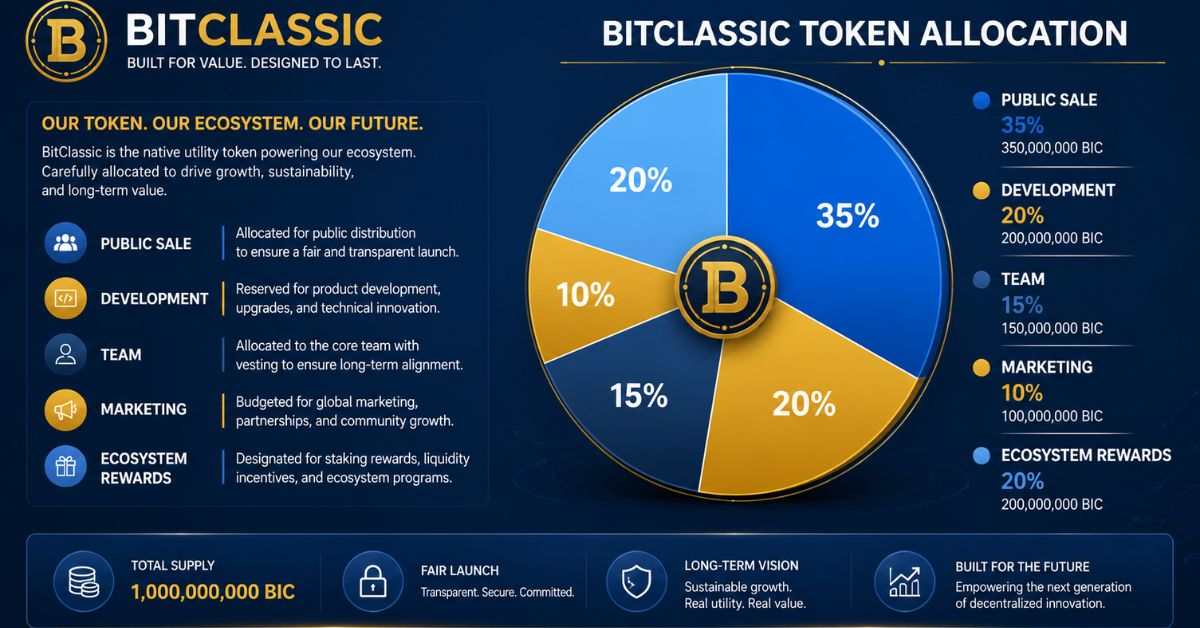
Tokenomics and Supply Structure
Tokenomics plays a critical role in determining sustainability and long-term value. A well-designed supply model prevents inflation and aligns incentives between developers and investors.
Key Token Elements
- Total supply cap
- Circulating supply
- Allocation structure
- Incentive mechanisms
Example Allocation Model
| Category | Allocation (%) |
| Public Distribution | 40% |
| Development Fund | 20% |
| Team & Advisors | 15% |
| Marketing | 10% |
| Ecosystem Incentives | 15% |
Why Tokenomics Matters
- Controls inflation
- Encourages long-term holding
- Supports development funding
- Builds investor confidence
Transparent distribution models often attract more trust in the crypto space.
Key Features and Competitive Advantages
The success of any cryptocurrency depends on bitclassic unique value proposition.
Core Features
- Fast transaction processing
- Low transaction fees
- Secure blockchain infrastructure
- Community-driven governance
- Potential staking rewards
Additional Strengths
- Compatibility with digital wallets
- Transparent blockchain explorer
- Ecosystem expansion potential
- Integration possibilities with DeFi or NFTs
Practical Impact
- Low fees improve merchant adoption
- Speed enhances the user experience
- Governance increases engagement
- Security strengthens trust.
These elements aim to create a balanced ecosystem combining performance and reliability.
Comparison With Major Cryptocurrencies
To evaluate its position in the market, comparing it with established digital assets provides context.
| Feature | This Project | Bitcoin | Ethereum |
| Primary Use | Utility & Payments | Store of Value | Smart Contracts |
| Fees | Low | Higher | Variable |
| Speed | Fast | Moderate | Fast |
| Governance | Community-Based | Limited | Developer & Communi |
Key Observations
- Bitcoin focuses on scarcity and security.
- Ethereum emphasizes programmable contracts.
- Emerging projects aim for scalability and affordability.
Comparisons help investors determine whether the asset fits their financial strategy.
Real-World Applications
Practical use cases drive demand and ecosystem growth.
Potential Applications
- Online payments
- Cross-border transfers
- Digital asset trading
- DeFi integration
- Gaming or NFT ecosystems
Example Scenario
Case Study: Online Retailer
A small e-commerce business adopts bitclassic coin as a payment method:
- Reduces transaction processing fees
- Gains access to international customers
- Receives near-instant settlement
Such real-world implementation enhances utility and increases adoption potential.
Security and Transparency Measures
Security is a cornerstone of blockchain systems.
Built-In Protections
- Advanced encryption
- Decentralized verification
- Public ledger auditing
- Community oversight
Investment Opportunities and Risks
Digital assets offer potential growth but also carry risks.
Potential Advantages
- Early-stage adoption opportunity
- Structured token supply
- Growing community
Risks to Consider
- Market volatility
- Regulatory uncertainty
- Competitive market pressure
- Liquidity challenges
Smart Investing Tips
- Diversify your portfolio
- Conduct independent research
- Review roadmap updates
- Avoid emotional trading
Balanced risk assessment is essential before investing in any cryptocurrency.
Roadmap and Future Outlook
Long-term sustainability depends on consistent development.
Typical Growth Phases
- Initial launch
- Exchange listings
- Wallet integrations
- Partnerships
- Network upgrades
Future Growth Drivers
- Technological innovation
- Increased adoption
- Strategic collaborations
- Community expansion
A transparent and realistic roadmap indicates long-term commitment.
FAQs
What is the main purpose of this cryptocurrency?
It is designed to enable secure, decentralized transactions while supporting ecosystem growth.
How is it different from Bitcoin?
Bitcoin primarily serves as a store of value, while newer projects often focus on scalability and practical applications.
Is it suitable for long-term investment?
That depends on your risk tolerance, research, and understanding of market volatility.
Where can I store the tokens?
They can typically be stored in compatible digital wallets that support the blockchain network.
Is the network secure?
Its blockchain structure uses cryptographic protection and decentralized validation for security.
Conclusion
The cryptocurrency industry continues to expand, offering innovative financial solutions beyond traditional banking systems. This project aims to contribute to that evolution by combining decentralization, transparency, and usability within a structured ecosystem.
In this guide, we explored its purpose, technology, tokenomics, features, real-world applications, investment considerations, and future roadmap. While bitclassic presents promising opportunities, it’s essential to conduct thorough research and approach investments responsibly.
As blockchain technology advances, well-structured projects with clear visions and sustainable models are more likely to thrive. Stay informed, prioritize security, and continue learning to navigate the dynamic world of digital assets effectively.
