

Introduction
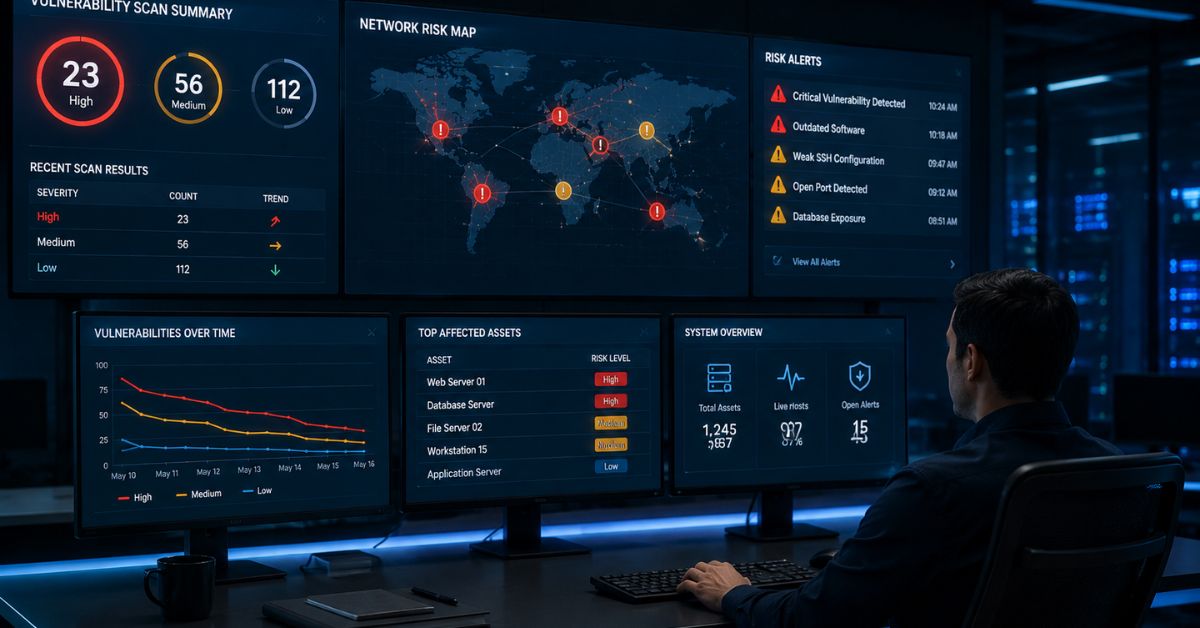
Cyberattacks are no longer rare events; they are daily occurrences affecting businesses of all sizes. From ransomware targeting hospitals to data breaches exposing millions of customer records, the consequences of weak security can be devastating. One of the most effective ways organizations defend themselves is through Vulnerability Scanning, a proactive and automated cybersecurity process designed to detect weaknesses before attackers exploit them.
Vulnerability scanning inspects networks, applications, cloud systems, and hardware assets to uncover known security flaws, outdated software, configuration errors, and compliance gaps. Instead of waiting for an incident to happen, companies can identify risks early and fix them efficiently.
In this comprehensive guide, you’ll learn how It works, its different types, tools, benefits, limitations, and best practices. Whether you’re an IT manager, cybersecurity student, or business owner, this article will help you understand how to build a stronger security posture and reduce cyber risk effectively.
When you check for vulnerabilities, why is it important?
Vulnerability scanning is an automated security assessment process that identifies weaknesses in IT systems. These weaknesses may include unpatched software, open ports, weak encryption protocols, or misconfigured firewalls.
Unlike penetration testing, which simulates real-world attacks, It focuses on discovering known issues using databases like the Common Vulnerabilities and Exposures (CVE) list.
Key Functions of Vulnerability Scanning
- Detects outdated software and missing security patches
- Identifies misconfigurations in servers and network devices
- Scans open ports and exposed services
- Compares findings against vulnerability databases
- Generates prioritized risk reports
Organizations rely on scanning tools to maintain compliance with standards such as the following:
- ISO 27001
- PCI-DSS
- HIPAA
- NIST Cybersecurity Framework
In today’s threat landscape, where attackers automate their own scanning processes, failing to scan your environment regularly is equivalent to leaving your doors unlocked.
Types of Vulnerability Scanning
There isn’t a one-size-fits-all approach. Different types of scans serve different purposes depending on your infrastructure.
Network-Based Scanning
is mainly about finding weak spots in network equipment like firewalls, routers, and switches.
Host-Based Scanning
Examines servers, workstations, and endpoints for configuration flaws or outdated software.
Web Application Scanning
Finds problems like SQL injection, cross-site scripting (XSS), and authentication that isn’t safe.
Database Scanning
Analyzes database systems for weak credentials and configuration issues.
Cloud Vulnerability Scanning
Assesses cloud environments (AWS, Azure, Google Cloud) for misconfigurations and compliance risks.
| Scan Type | Primary Focus | Example Risk Detected |
| Network Scan | Network devices | Open ports |
| Web App Scan | Applications | XSS, SQL injection |
| Host Scan | Servers/Endpoints | Missing patches |
| Cloud Scan | Cloud assets | Misconfigured storage |
Choosing the right mix ensures complete coverage of your digital assets.
How Vulnerability Scanning Works
Understanding how the process works helps you interpret results more effectively.
The scanning process generally follows these steps:
- Asset Discovery: Identifying all connected devices and systems.
- Port Scanning: Detecting open and exposed services.
- Vulnerability Identification: Matching findings against CVE databases.
- Risk Assessment: Assigning severity using CVSS (Common Vulnerability Scoring System).
- Reporting: Generating detailed remediation guidance.
Key Components
- CVE databases
- CVSS scoring
- Automated scanning engines
- Reporting dashboards
Scanners continuously update vulnerability signatures to detect newly discovered threats.A lot of tools also work with SIEM and endpoint detection platforms so that tracking is always going on.
Benefits of Regular Vulnerability Scanning
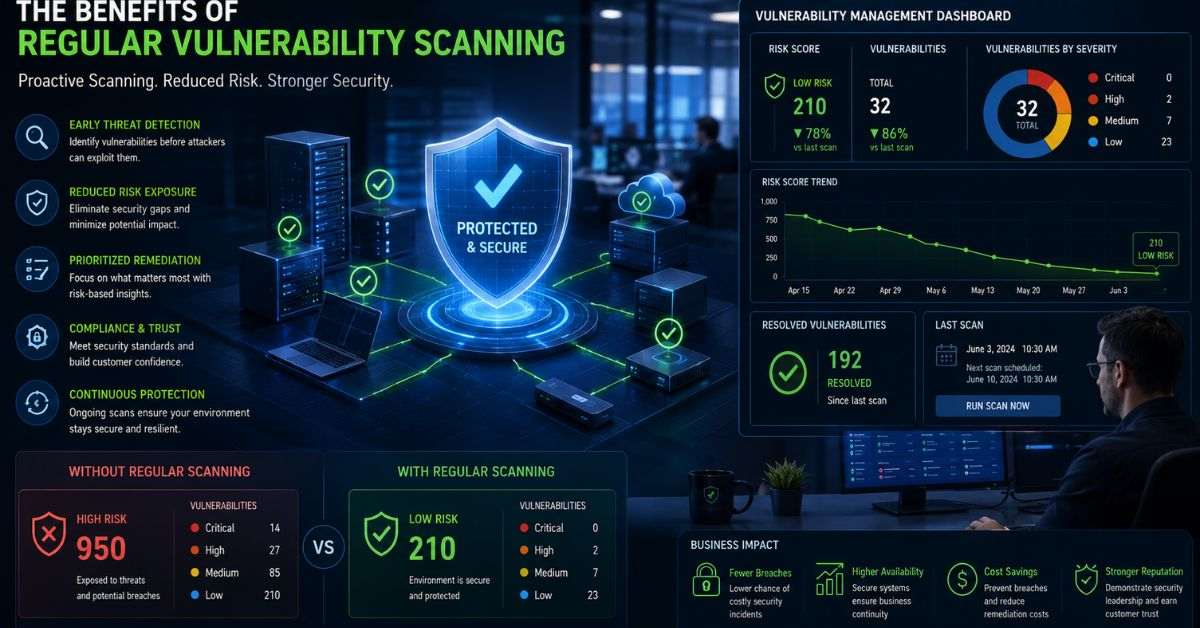
Conducting vulnerability scanning regularly offers measurable business and security benefits.
Major Advantages
- Early detection of security weaknesses
- Reduced attack surface
- Improved compliance posture
- Lower risk of data breaches
- Better resource allocation through risk prioritization
According to IBM’s Cost of a Data Breach Report, the average data breach costs over $4 million globally. Proactive scanning can significantly reduce incident response costs.
Case Study: Mid-Sized E-Commerce Company
A retail company conducted quarterly scans and discovered:
- 120 outdated plugins
- 3 critical server vulnerabilities
- 2 exposed admin interfaces
After remediation:
- Security incidents dropped by 60%.
- PCI compliance audit passed successfully
- Downtime reduced significantly
Regular scanning strengthens organizational resilience and protects brand reputation.
Vulnerability Scanning vs Penetration Testing
These two security practices are often confused but serve different purposes.
| Feature | Vulnerability Scanning | Penetration Testing |
| Automation | Automated | Manual + Automated |
| Frequency | Continuous/Regular | Periodic |
| Goal | Identify known flaws | Exploit weaknesses |
| Cost | Lower | Higher |
Key Differences
- Scanning identifies vulnerabilities.
- Penetration testing validates exploitability.
- Scanning is broader; pen testing is deeper.
Both are essential components of a mature cybersecurity strategy.
Popular Vulnerability Scanning Tools
The market offers various commercial and open-source tools.
Widely Used Tools
- Nessus: Comprehensive commercial scanner
- OpenVAS: Open-source alternative
- Qualys: Cloud-based security platform
- Rapid7 InsightVM: Enterprise-grade vulnerability management
- Nmap: Network discovery and port scanning
Features to Compare
- Reporting capabilities
- Cloud compatibility
- Integration with SIEM
- Automated patch management
- Compliance mapping
Selecting the right tool depends on organization size, infrastructure complexity, and compliance requirements.
Best Practices for Effective Vulnerability Scanning
Running scans is not enough, you need a structured strategy.
Best Practices
- Conduct scans monthly or quarterly
- Perform scans after major system changes
- Prioritize critical vulnerabilities
- Validate false positives
- Integrate with patch management systems
- Maintain an updated asset inventory
Organizations should also adopt a risk-based approach rather than fixing vulnerabilities randomly. Continuous monitoring combined with strong remediation processes maximizes effectiveness.
Challenges and Limitations
While valuable, It has limitations.
Common Challenges
- False positives
- False negatives
- Scan performance impact
- Incomplete asset visibility
- Overwhelming reports
Automated tools cannot detect zero-day vulnerabilities unless signatures exist. Additionally, human oversight is required to interpret findings accurately. Combining scanning with penetration testing and threat intelligence improves overall detection accuracy.
Compliance and Regulatory Requirements
Many regulatory standards require regular security assessments.
Regulations That Require Scanning:
- PCI-DSS (quarterly scans mandatory)
- HIPAA (risk assessments required)
- GDPR (data protection measures)
- SOC 2 compliance
Failure to conduct proper assessments can lead to fines, lawsuits, and reputational damage.
For official compliance guidance, refer to:
- National Institute of Standards and Technology
- PCI Security Standards Council
Regulatory compliance strengthens customer trust and legal protection.
Future Trends in Vulnerability Scanning
The cybersecurity landscape is evolving rapidly.
Emerging Trends
- AI-driven vulnerability detection
- Cloud-native security scanning
- DevSecOps integration
- Continuous attack surface management
- Automated remediation workflows
Modern organizations are shifting toward continuous vulnerability management rather than periodic scanning. As remote work and cloud adoption expand, security tools must adapt to distributed environments.
FAQs
How often should vulnerability scanning be performed?
Most organizations perform scans monthly or quarterly. High-risk industries may require continuous monitoring.
Is It enough to secure my system?
No. It should be combined with penetration testing, firewalls, endpoint protection, and employee awareness training.
Can small businesses benefit from vulnerability scanning?
Absolutely. Small businesses are common cyberattack targets and benefit greatly from automated scanning tools.
Does vulnerability scanning affect system performance?
Some scans may temporarily impact performance, especially intensive network scans. Scheduling during off-hours helps.
What’s the difference between scanning inside and scanning outside?
Internal scans assess inside network risks, while external scans evaluate public-facing assets.
Conclusion
In an era where cyber threats evolve daily, Vulnerability Scanning remains one of the most critical defensive strategies for organizations of all sizes. By proactively identifying weaknesses in networks, applications, and cloud environments, businesses can significantly reduce their exposure to attacks.
We explored how scanning works, its types, tools, benefits, compliance requirements, and best practices. While it’s not a complete solution on its own, it forms the backbone of a strong cybersecurity framework when combined with penetration testing and continuous monitoring.
As someone experienced in cybersecurity research and risk assessment, I strongly recommend integrating automated vulnerability management into your security strategy. Refer to trusted frameworks like NIST and PCI SSC for compliance guidance.
